.svg)
26 June 2026

Minerva has published an early look at the 2026 UK Proxy Season, finding that shareholder dissent across the UK market remained selective rather than widespread, but proved consequential where investors focused their opposition on governance, board accountability and shareholder rights.
The UK proxy season provides a snapshot of institutional investor voting behaviour across listed companies. Voting outcomes offer insights into investor priorities on board accountability, executive remuneration, shareholder rights and governance, while highlighting where concerns translate into meaningful opposition at annual general meetings.
This review covers 186 annual general meetings held by companies in the Solactive UK 350 Index between 1 January and 31 May 2026, representing 53% of the index. Across 3,740 resolutions, average opposition to management stood at 3.38%, while only 3.07% of resolutions crossed the 20% high-dissent threshold under the UK Corporate Governance Code.
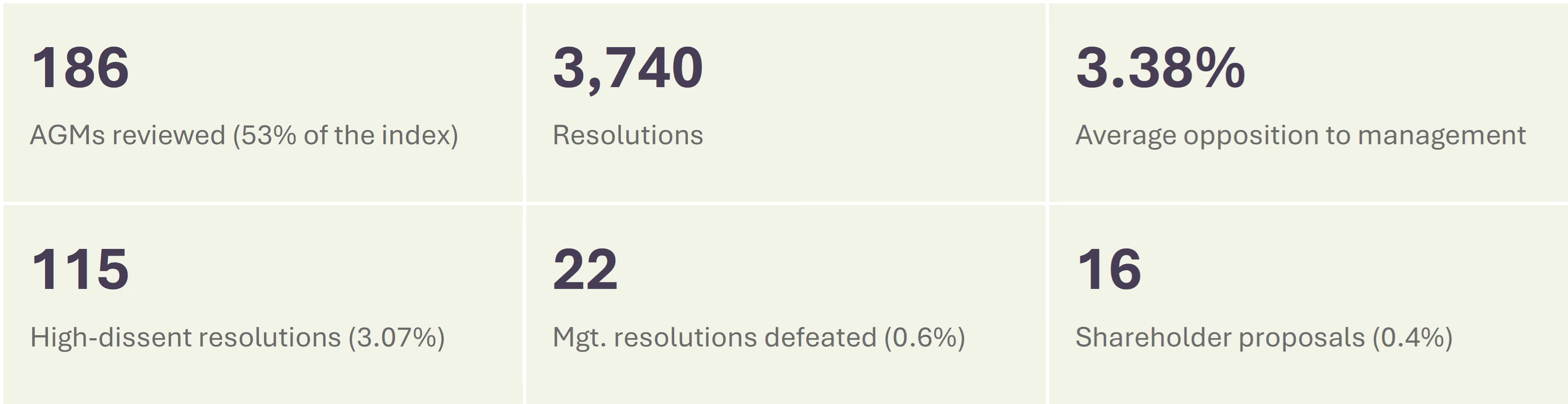
However, the report finds that dissent was concentrated in a small number of high-profile situations where the impact was significant. BP removed its chair within days of its annual general meeting following governance concerns, while Edinburgh Worldwide Investment Trust saw five management-backed directors defeated as part of a wider board reset linked to an activist campaign.
Minerva’s analysis shows board accountability was the clearest pressure point of the season. Director elections accounted for the largest share of high-dissent outcomes, with 36 management-proposed director candidates drawing opposition above 20% and five management-backed directors defeated.
“The 2026 UK proxy season was not defined by broad rebellion, but by targeted and consequential dissent. Investors largely supported management, yet where concerns over board accountability, process or shareholder rights became acute, the ballot delivered visible consequences. The message for issuers is clear: strong support cannot be taken for granted where trust, transparency or governance mechanics are in question.”
Thomas Bolger, Stewardship Lead, Minerva Analytics
Remuneration remained another area of scrutiny, although no pay resolution was defeated. High dissent affected 11.34% of remuneration policy votes and 5.85% of remuneration report votes, suggesting investors were more willing to challenge forward-looking pay frameworks than retrospective outcomes.
The report also highlights the growing importance of governance mechanics. Special-resolution thresholds, board discretion and concentrated ownership shaped several outcomes, particularly on capital authorities, virtual meeting provisions and shareholder rights.









.jpg)