
.svg)
AI giant Anthropic's investors are reportedly urging the company to list at a valuation of more than U$2 trillion, a move that would break the record set by SpaceX's IPO earlier this year and could come as soon as October. The proposal would mark a significant escalation in AI market valuations and potentially create one of the largest public offerings in history.
Yet the most important question for prospective investors may not be the valuation itself, but what governance rights they receive in return. As enthusiasm for AI continues to drive valuations higher, Anthropic's IPO could become a defining test of how far public investors are willing to trade voting power and accountability for access to the sector's growth prospects.
Reports this week suggested Anthropic investors are lobbying for a US$2 trillion valuation ahead of the company's long-anticipated IPO. While a listing had broadly been expected later this year or in early 2027, reports now indicate it could launch as soon as October. The timing is notable. Anthropic would be approaching public markets shortly after SpaceX's record-breaking debut, alongside preparations for potential listings by other major AI firms and during SEC Chair Paul Atkins' “Make IPOs Great Again” initiative.
Earlier this year, Anthropic reportedly became the world's most valuable AI start-up after raising U$65 billion in Series H funding, pushing its valuation to U$965 billion. Investors have reportedly argued that rapid revenue growth could justify a valuation of more than double that figure, with some forecasts suggesting annual revenue could exceed U$100 billion by the end of 2026.
Anthropic confidentially submitted an S-1 registration statement to the SEC in June, although it has yet to disclose details of its future voting structure. That question may prove as important as the valuation itself. Many high-profile technology listings have retained dual-class share structures (DCSS), allowing founders and early investors to maintain outsized voting control after listing. Minerva Analytics has previously highlighted that more than 40% of US technology IPOs have adopted similar arrangements.
The governance implications are particularly relevant because calls for the U$2 trillion valuation are reportedly coming from investors who already hold stakes in the company. While DCSS can provide management stability and support long-term strategic decision-making, they can also limit the ability of public investors to influence company direction or hold boards accountable through shareholder voting. This week, reports highlighted concerns that senior officials at Norges Bank Investment Management, the world's largest sovereign wealth fund, have around DCSS and IPOs. The governance terms attached to the IPO may therefore matter as much as the headline valuation.
Governance considerations extend beyond voting rights. Anthropic investors have reportedly encouraged CEO Dario Amodei to soften public messaging around AI-related risks ahead of the proposed listing. This comes amid growing scrutiny of frontier AI developers. Last month, more than 1,300 employees from leading AI companies signed an open letter highlighting concerns around advanced AI systems, while US lawmakers have recently sought information from Anthropic and OpenAI regarding the risks posed by increasingly capable AI agents.
Against that backdrop, an earlier public listing could offer AI companies an opportunity to capitalise on strong investor enthusiasm before regulatory scrutiny intensifies further. The debate is therefore not simply about valuation, but also about how public markets assess governance and oversight risks associated with rapidly expanding AI businesses.
If Anthropic were to list at a U$2 trillion valuation, it would surpass SpaceX's IPO and become the largest public offering in history. SpaceX's listing demonstrated the extraordinary capital-raising potential available to companies entering public markets while still maintaining significant insider control.
SpaceX's governance arrangements attracted criticism from some investors, particularly given its DCSS. The debate was amplified by Nasdaq's decision to permit rapid index inclusion, potentially requiring passive funds to purchase shares before governance risks had been fully evaluated by the market. Anthropic's listing could prompt similar discussions, particularly if it adopts comparable voting arrangements.
OpenAI is also reportedly preparing for a public listing, although current expectations point towards 2027. The company confidentially submitted its own S-1 filing the week after Anthropic and recently completed a substantial share buyback programme. Together, these developments suggest that public markets may soon face a wave of listings from some of the world's most influential AI developers.
These potential listings are unfolding against the backdrop of Chair Paul Atkins' “Make IPOs Great Again” initiative. The SEC has argued that regulatory burdens have discouraged companies from pursuing public listings and has proposed measures designed to simplify capital raising and expand regulatory accommodations for issuers.
However, as the heatmap below demonstrates, created using US SEC data and showing the total number of H1 IPOs from 2000 to 2026, IPO activity has recovered strongly in recent years following a post-2021 slowdown, markedly increasing year-on-year since 2023.
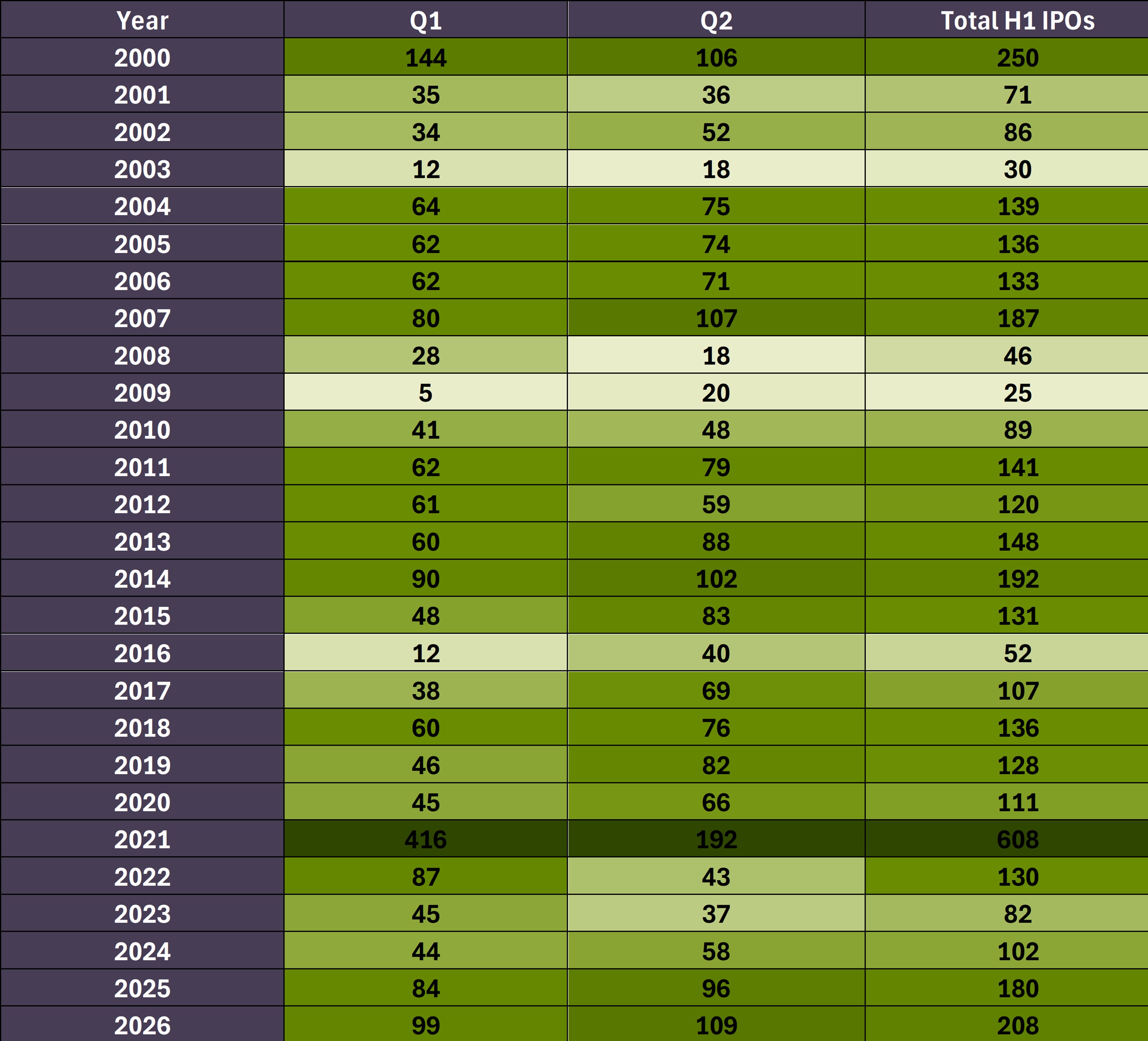
The US recorded 208 IPOs in the first half of 2026, ahead of the 180 recorded during the same period in 2025. Excluding the exceptional conditions of 2021, this represents the strongest first-half performance since 2000. The data suggests that market appetite for new listings remains robust, even before any further regulatory easing is implemented.
Competition for listings is also becoming increasingly international. Regulators in several jurisdictions are adjusting listing frameworks to attract issuers, including the UK, where the Financial Conduct Authority moved to further simplify IPO rules just last week to strengthen the competitiveness of British markets.
Whether Anthropic ultimately lists at U$2 trillion or below, the proposed IPO is likely to become a defining governance test for the AI sector. Public investors appear eager to gain exposure to leading AI companies, but the terms on which that access is granted will matter. The central question may not be whether investors believe in AI's growth prospects, but how much governance influence they are prepared to surrender to participate. As valuations continue to rise, scrutiny of voting rights, board accountability and shareholder protections is likely to intensify.



.jpg)