20 August 2025
Jack Grogan-Fenn
August 20, 2025
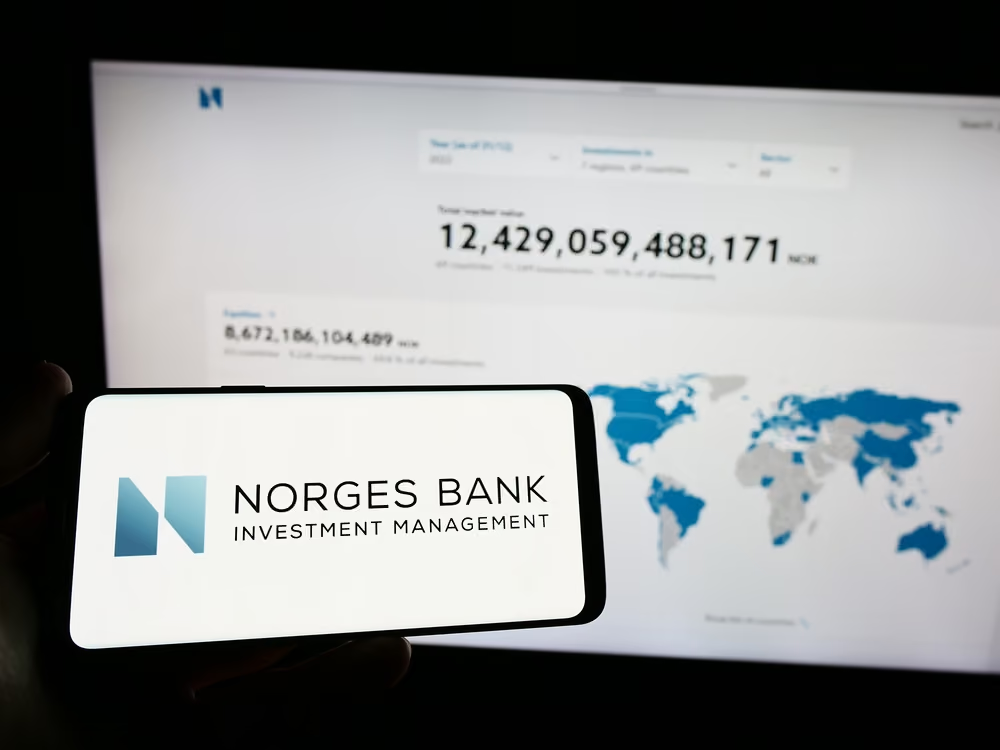
Norges Bank Investment Management (NBIM) has excluded six further Israeli companies linked to Gaza and the West Bank from its portfolio over ethical concerns.
This follows the world’s largest sovereign wealth fund, which represents U$1.8 trillion in AUM, opting to divest from 11 Israeli firms last week. The news of the six additional exclusions was part of a letter sent to Norway’s Ministry of Finance and comes as Israel ramps up its military campaign against Palestine.
It had been reported last week that NBIM was mulling further divestment from Israeli companies in the light of ongoing events. Jens Stoltenberg, Norway’s Finance Minister, has said that more companies could be excluded by NBIM going forward.
As of August 14, 2025, NBIM had NOK 19 billion (U$1.9 billion) invested in 38 companies listed in Israel. This marked a decrease of NOK 4 billion and 23 companies compared to June 30, 2025.
NBIM has not yet named any of the 17 companies it has chosen to exclude since the start of this month, but the organisation intends to name them when the divestments are completed along with specific justifications for pulling investment.
The decision to divest was made in response to Norway’s Ministry of Finance sending a letter to NBIM requesting that the fund review its investments in Israeli companies.
Following the choice to exclude the initial 11 companies, NBIM’s CEO Nicolai Tangen said that the measures were responding to the “extraordinary circumstances” arising from the “serious humanitarian crisis” in Gaza.
“We are invested in companies that operate in a country at war, and conditions in the West Bank and Gaza have recently worsened,” said Tangen. “In response, we will further strengthen our due diligence. The measures we are taking will simplify the management of our investments in this market and reduce the number of companies that we and the Council on Ethics monitor.”
NBIM stated that is has contacted more than 60 companies about due diligence and risk-reducing measures in war and conflict areas, including undertaking dialogue with over 30 companies with operations connected to the West Bank and Gaza. Last year, the fund started specific reviews of Israeli companies, classifying them as low, medium or high risk.
All companies deemed as high risk have either been sold or assessed by the Council on Ethics, with NBIM selling their stakes in ten Israeli firms between the start of 2024 and summer 2025.
Following the letter from the Norwegian Ministry of Finance conducted a new review of the Israeli companies in the fund's equity portfolio. Public information was used to assess the nature of the business, corporate governance and management, whether the company has operations in occupied areas or has financed the development of settlements and contracts with Israeli defence.
“The war in Gaza is a humanitarian crisis,” the letter read. “The situation in the West Bank and Gaza continues to worsen and causes tremendous human suffering. Norges Bank fully understands that questions about the fund's investments in Israeli companies are raised at this time.”
NBIM last week also confirmed that all investments in Israeli companies that have been managed by external asset managers will be moved inhouse and managed internally, with the fund terminating contracts with external managers in Israel.
Other sovereign wealth funds have divested from companies with links to Israeli settlements, with Ireland selling shareholdings worth more than €1 million in two accommodation companies, reportedly Expedia Group and TripAdvisor. Ireland has also divested almost €3 million worth of shares from six other Israeli firms.
Similarly, Danish pension fund PBU divested from Expedia, as well as Airbnb and Booking Holdings, which have all been linked with Israel.
However, several Danish pension funds remain invested in Israeli companies linked with the West Bank. This includes AP Pension, ATP, PFA and PKA, who have reportedly invested millions of Krone into companies with alleged ties to Israel’s military.
This investment continues despite Denmark considering sanctions against Israel as the current holder of the EU presidency. Danish Prime Minister Mette Frederiksen reportedly said that Israel’s government was going "too far" in its actions in Gaza and the West Bank.
At the end of last month, fellow Nordic country Sweden publicly called for the trade component of the bloc’s association agreement with Israel to be suspended. “Economic pressure on Israel must increase,” said Ulf Kristersson, Prime Minster of Sweden, in a statement. “The Israeli government must allow unrestricted humanitarian aid in Gaza.”
It remains to be seen if pension funds in Denmark, other Nordic countries and beyond will follow NBIM in divesting from Israeli companies which could pose ethical and reputational risks. Investors are acutely aware of these risks, with shareholders specifically pushing technology company Intel for an impact assessment of their operations in Israel and defence company Lockheed Martin to disclose how their political activities intersect with human rights in the region, as reported by Minerva Analytics.
Denmark’s Danske Bank Group has, however, divested from most of its fossil fuel company investments. The move was made as the organisation implements its approach for investments in companies operating in the fossil fuel sector that assesses companies’ low-carbon transition plans which was introduced last year.
You can read more of our articles by clicking here.