.svg)
.jpg)
The SEC has decided to permanently stop responding to Rule 14a-8 ‘no action’ requests, removing the primary mechanism for resolving shareholder proposal exclusion disputes and likely pushing more disagreements towards litigation.
The decision means that the SEC will no longer act as the referee when companies seek to omit shareholder proposals from proxy statements. Instead, disagreements over exclusions are increasingly likely to be resolved through litigation, a shift that could have significant implications for investors and companies ahead of the 2027 proxy season.
The SEC announced at the end of last week that it had "determined to discontinue responding to Rule 14a-8 no-action requests entirely".
The move follows last year's decision not to respond to company ‘no action’ requests during the 2026 proxy season. That change allowed companies to exclude shareholder proposals without SEC staff review. Unlike the 2026 policy, which was initially presented as a seasonal measure, the Commission has now indicated that it is stepping away from the process altogether.
While the latest announcement is unlikely to surprise investors given the Commission's broader approach to shareholder rights under the Trump administration, it represents a significant shift in how shareholder proposal disputes will be handled. Questions that were previously reviewed by SEC staff will increasingly be left to companies, investors and, where disagreements escalate, the courts.
When the SEC first suspended responses to ‘no action’ requests, Minerva Analytics noted that the change risked granting corporate management greater discretion over proposal exclusions while reducing opportunities for investor oversight. Then-SEC Commissioner Caroline Crenshaw was also highly critical of the move, describing it as a "Trojan horse" that could undermine shareholder democracy.
Although the SEC will no longer provide responses, companies intending to exclude shareholder proposals must still submit notices to the Commission containing the information required under Rule 14a-8.
The Commission said the decision reflected its intention to focus Division resources on the review of Securities Act and Exchange Act filings "for the protection of investors and facilitation of capital formation", while pointing to the extensive body of existing Commission and staff guidance on Rule 14a-8.
The 2026 proxy season provided early indications that the policy shift was already influencing the shareholder proposal landscape. US shareholder proposals declined noticeably during the first half of 2026 compared with previous years, according to Minerva Analytics data.
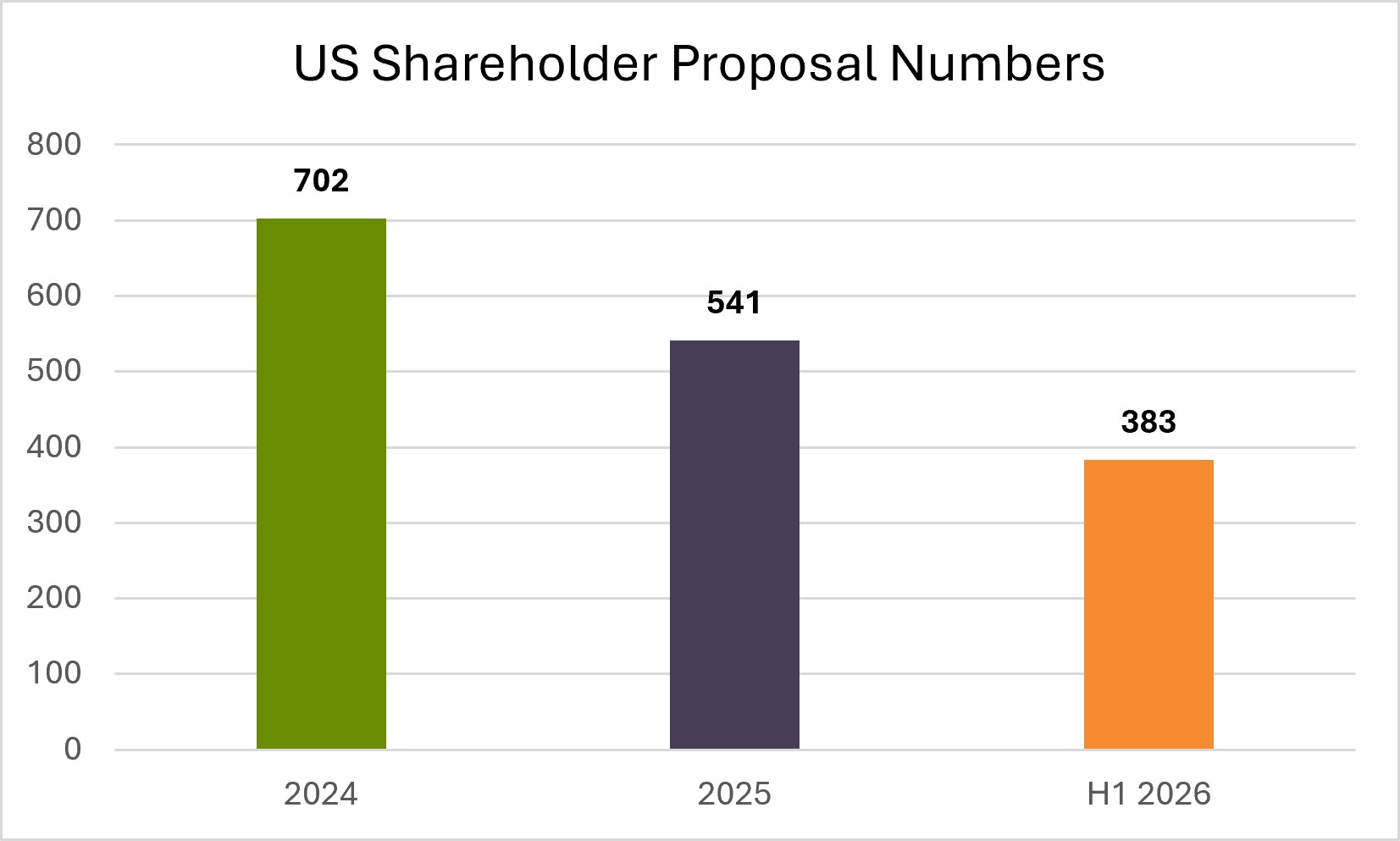
While the figures for 2024 and 2025 represent full-year totals and 2026 covers only the first half of the year, most US shareholder proposals are typically submitted and voted during the first-half proxy season. As a result, any increase in proposal volumes during the remainder of 2026 is unlikely to materially change the overall trend.
The decline is significant. Proposal volumes in H1 2026 were more than 150 lower than the total recorded during 2025 and around 45% below 2024 levels. While multiple factors can influence filing activity, the trend suggests that changes to the ‘no action’ process may already be reshaping the incentives facing proponents and issuers. With the SEC now formally withdrawing from the process, proposal activity could face additional pressure during the 2027 proxy season.
The shift has also brought litigation risks into sharper focus. During the 2026 proxy season, several disputes over excluded shareholder proposals ended up in court, including cases involving AT&T, Axon, Chubb and PepsiCo.
These cases suggest that investors remain willing to challenge disputed exclusions through legal channels when regulatory review is unavailable. Notably, companies prevailed in only one of these cases, while several excluded proposals were ultimately returned to proxy materials.
As Rule 14a-8 oversight continues to diminish, the courts may increasingly become the forum for resolving disagreements that were previously addressed through the SEC's ‘no action’ process. This raises the prospect of higher costs, longer resolution timelines and greater reputational scrutiny for both investors and companies.
Speaking last month, SEC Chair Paul Atkins argued that "the world did not end simply because the Commission staff stopped responding to no-action requests". He noted that some observers had predicted widespread proposal exclusions, while others expected litigation risk and proxy adviser scrutiny to encourage companies to continue including proposals they believed were excludable.
The SEC's withdrawal from the ‘no action’ process comes as broader questions continue to surround the future of Rule 14a-8 itself.
In June, reports emerged that the Commission was considering repealing Rule 14a-8 entirely. Minerva cautioned at the time that removing the framework could result in a more fragmented shareholder engagement environment across US markets.
Although the SEC delayed its review of the shareholder proposal process until October, reducing the likelihood of immediate disruption to the 2027 proxy season, uncertainty around the future of the rule remains.
Last month, a coalition of investors submitted a rulemaking petition urging the SEC to "recalibrate" rather than "dismantle" Rule 14a-8 and to retain the ‘no action’ process. The petition argued that shareholder proposals remain an important mechanism for accountability and engagement, and that eliminating the framework would create significant disruption for stewardship and investment activities. Signatories included New York State Comptroller Thomas DiNapoli, Ceres, the Interfaith Center on Corporate Responsibility, the Shareholder Rights Group and US SIF.
The SEC's decision to end responses to ‘no action’ requests marks another significant change to the shareholder proposal regime in the US. More importantly, it confirms that the Commission no longer intends to play its longstanding role in adjudicating disputes over proposal exclusions.
The immediate consequence is that disagreements once filtered through SEC staff review are increasingly likely to be resolved through litigation. Whether Rule 14a-8 is ultimately reformed, retained or repealed, investors and companies should prepare for a shareholder proposal landscape in which the courts play a larger role and regulatory intervention plays a much smaller one.