.svg)
24 June 2025
Jack Grogan-Fenn
June 24, 2025
Minerva Analytics’ CEO Sarah Wilson has warned that proxy advisors are “under siege” following a series of high-profile attacks by US policymakers.
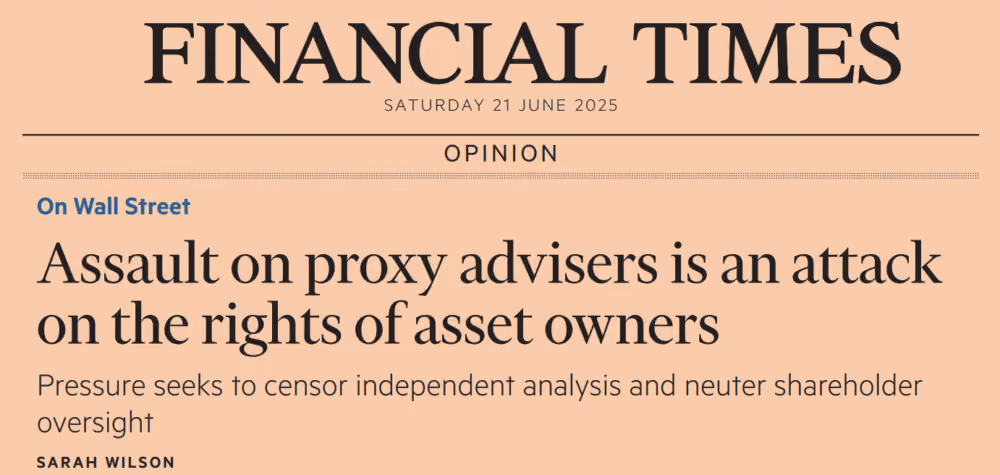
In an article written for the Financial Times, Wilson said that a “simmering backlash” over the activities of proxy advisory firms has “mutated into an all-out assault in the US from multiple directions”.
In recent months, the adversity facing proxy advisors has included congressional hearings, legal actions and regulatory pressure. Last month, J.P. Morgan chief executive Jamie Dimon also reportedly branded proxy advisors a “cancer”, as well as advocating their elimination.
“The proxy advisory firms are accused of cartel-like behaviour and ideological over-reach in their corporate governance advice with critics treating the fiduciaries who manage money with disdain, painting them as manipulated victims,” wrote Wilson.
“This should all be seen for what it is — a rejection of democratic accountability in the financial system by attempting to neuter shareholder oversight. The criticism misrepresents what proxy agents actually do in helping to execute votes for shareholders and providing research, parsing the dense and complex disclosures of thousands of listed companies.”
She added that the clients of proxy advisors are sophisticated institutional investors with their own voting policies that decide how their own votes are cast, with advisors only acting to help put clients’ voting preferences into action.
Last month, Minerva’s Wilson sent a letter to Ann Wagner, Chair of the US House’s Subcommittee on Capital Markets, and other subcommittee member, warning against the introduction of new regulation for proxy advisors. She stated that there was “no compelling legal, economic or fiduciary rationale for new proxy advisor regulation”.
In the letter, Wilson cautioned that new rules risk undermining intellectual property rights, conflicting with financial duties, distorting market incentives and detrimentally impacting investor confidence. She added that adding new regulation, such as complex disclosure or oversight requirements, risks creating high fixed compliance costs that disproportionately burden new entrants and further entrench incumbents.
The letter followed a hearing held in April by the US House of Representatives’ Committee on Financial Services entitled “Exposing the Proxy Advisory Cartel”, which considered the “role and influence” of proxy advisory firms in “shaping corporate governance and shareholder voting outcomes”.
Three Republican senators also sent a letter to the leaders of US proxy advisors last month detailing concerns that the proxy advisors are “influencing” US public policy on economic, environmental and social issues while operating with “virtually no transparency, minimal accountability, and no meaningful regulatory oversight”.
Last week, Minerva Analytics reported on Texas’ Senate Bill (SB) 2337. This bill will require proxy advisors that “deviate” from acting in the “financial interest” of shareholders to “clearly disclose that fact”. This includes advisors recommending votes based on environmental, social, or governance (ESG) investing, diversity, equity, or inclusion (DEI) factors, and social credit or sustainability scores.
On June 20, SB 2337 was signed by Texas Governor Greg Abbott, meaning the regulation will come into effect on September 1.
It applies to proxy advisor services provided to companies and other business entities that are organised or created under Texas law, have their principal place of business in Texas, or are a foreign entity proposing to become a domestic Texas entity by merger, conversion or otherwise.
“In the US, however, there are attempts to force free pre-disclosure of research to companies ahead of clients, to classify research as “proxy solicitation”, or to introduce politically-motivated constraints on ESG criteria,” wrote Wilson. “These are not neutral regulatory improvements. They are efforts to shift power from shareholders to corporate management, insulating boards from scrutiny and muting dissent.”
Last week, the CEO of the California Public Employees' Retirement System - the US’ largest public pension fund – also advised that eliminating or weakening the use of proxy advisory firms risks eroding US institutional investors and corporate governance.
Wilson noted that, unlike the US, both the UK and EU recognise that proxy research is “commissioned by sophisticated capital providers to address the issues that they want to know about”, rather than an “ideology that is imposed upon them” as suggested by some in the US.
“Through the Shareholder Rights Directive and related disclosure regulations, the EU has reinforced the rights of shareholders to engage on material risks, including those related to sustainability,” wrote Wilson. “The EU does not treat proxy advisers as a problem to be solved, but as an information instrument integral to healthy market functioning and accountability.”
She said that the core aim of the Shareholder Rights Directive was to “strengthen the rights of shareholders to exercise meaningful corporate governance oversight” and ensure that asset owners have the “absolute right to choose how they exercise their rights”.
Wilson also pointed to the European Commission’s recent case against Italy for violating the directive in allowing companies to appoint a single, exclusive proxy to represent all shareholders at annual meetings, effectively bypassing independent voting.
“Overall, this assault on proxy agencies is a test of whether liberal capitalist democracies still believe in the right of asset owners to govern the capital they provide,” Wilson concluded. “The question that remains is both simple and telling: why are corporate issuers so afraid of their owners? Why do they fear scrutiny from the very capital providers who fund their operations, bear their risks and ultimately underwrite their licence to operate?”
You can read more of our articles by clicking here.