.svg)
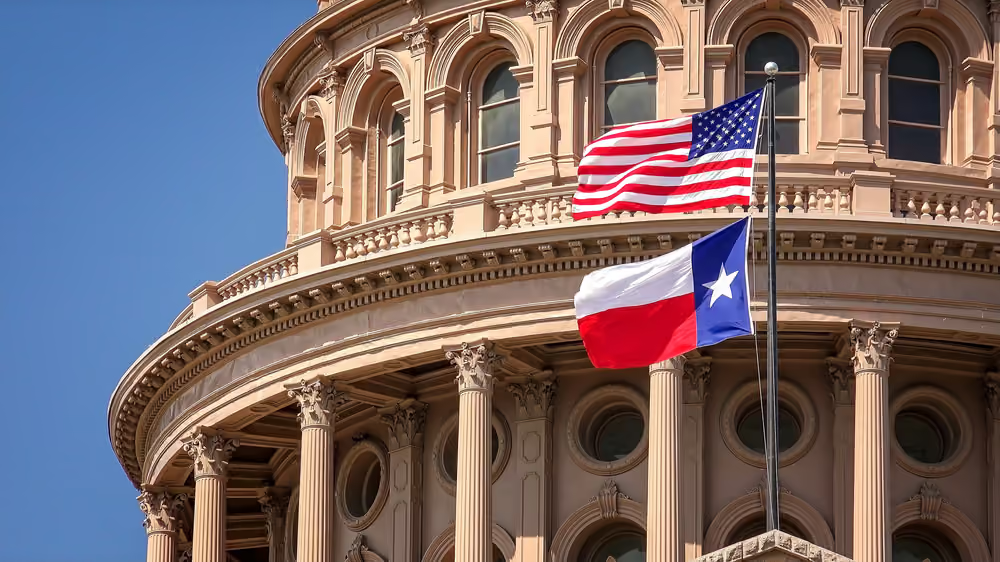
The Texas Stock Exchange (TXSE) began public trading on 10 July, adding a new venue to US markets. Its significance lies less in its initial trading activity than in what it may represent: the continued emergence of a Texas governance model that gives management greater flexibility while reducing some of the traditional avenues through which shareholders exert influence.
TXSE launched with a limited group of securities and no listed companies on day one. Backed by major financial institutions including BlackRock, Bank of America, Goldman Sachs and J.P. Morgan, and approved by the SEC in late 2025, the exchange enters the market with substantial institutional support.
The key question is not simply whether TXSE can attract listings from the NYSE and Nasdaq. It is whether it becomes part of a broader governance ecosystem increasingly associated with Texas.
That ecosystem has gained prominence as companies look for alternatives to traditional corporate jurisdictions. Texas has sought to position itself as a business-friendly environment through legal reforms, a specialist business court and a regulatory approach that many market participants view as more accommodating to corporate management.
At the same time, a strong IPO market has enhanced issuers' ability to set governance terms. Recent listings, especially the record-breaking SpaceX IPO, have highlighted investors' willingness to accept structures that concentrate control in founders or management teams in return for access to high-profile companies. When demand is strong, companies have greater scope to decide not only how they are governed, but also where they list.
US Securities and Exchange Commission Chair Paul Atkins has heavily pushed IPOs in the form of his highly publicised “Make IPOs Great Again” campaign. In a speech last week, he urged states that are “competing to become - or remain - the leading destination for corporate domestication to ensure that their corporate laws do not enable the politicization of shareholder meetings”, with Texas being one of these states. This could well prove damaging to shareholders and provides another example of the scepticism shown towards some investors by Atkins and the Commission under his leadership.
ExxonMobil's move to Texas provides the clearest example of how these governance debates are playing out in practice.
Shareholders approved the company's redomicile from New Jersey to Texas at its May AGM, with 70.5% voting in favour and 28.5% against. While the proposal passed comfortably, the level of dissent was notable compared with most other resolutions on the ballot.
A significant feature of the vote was ExxonMobil's retail shareholder voting programme, which allows investors to adopt standing voting instructions, including an option to vote in line with board recommendations unless actively overridden. Given that retail investors own a substantial portion of the company's shares and historically participate at lower rates than institutional investors, the programme illustrates how voting design can influence governance outcomes.
The broader lesson is not that ExxonMobil's move lacked legitimacy. Rather, it highlights how governance outcomes are increasingly shaped not only by formal shareholder rights, but also by the mechanisms through which those rights are exercised. Voting defaults, standing instructions and participation levels can all affect the balance between boards and investors.
That connection is particularly relevant for TXSE. Exchange Chairman and Chief Executive James H. Lee has pointed to ExxonMobil's approach as a model for increasing retail shareholder participation and reducing reliance on proxy advisors. Critics see this auto-vote model as a ‘rubber stamp’ for management-backed resolutions, though such a policy certainly increases shareholder participation on paper.
Viewed together, corporate domicile, listing venue and voting architecture are becoming more closely linked. A company that relocates to Texas, lists on TXSE and adopts voting structures aligned with management recommendations may be making a series of decisions that collectively diminished the influence of shareholders.
As Texas continues to develop its own corporate governance framework, TXSE could become more than a new place to trade securities. It could emerge as an important piece of a broader governance model that rebalances the relationship between management and shareholders. For investors, that makes the exchange worth watching not only for who lists there, but for what those companies signal about the future direction of corporate governance.





-1.avif)