22 October 2026
Tesla’s 2026 AGM has no shareholder proposals on the ballot for the first time since 2013, despite two being submitted. Investors will instead vote on just three company-sponsored resolutions at the 3 December meeting, making the empty shareholder portion of the ballot particularly striking.
The timing matters. As the SEC considers rescinding Rule 14a-8, potentially reshaping how investors get proposals onto US company ballots, changes within Tesla could also affect shareholder influence. Its new retail voting programme allows standing instructions centred on board recommendations, potentially increasing g management-aligned voting depending on uptake. For active stewards, the 2026 AGM therefore points to changes on both sides of shareholder voice: access to the ballot and influence over the outcome.
The first proposal, submitted by Joanne Morris, asked Tesla to separate Optimus and its US-manufactured artificial intelligence activities from the company. Tesla sought exclusion principally on procedural eligibility grounds, including alleged deficiencies relating to evidence of ownership and other requirements under Rule 14a-8.
The second, from Elektra Printz, requested an annual customer-experience accountability report covering response times, issue resolution, customer satisfaction, staffing and access to human customer service representatives. Tesla argued that it had substantially implemented the proposal under Rule 14a-8(i)(10), that it concerned ordinary business and micromanagement under Rule 14a-8(i)(7), and that it sought to redress a personal grievance under Rule 14a-8(i)(4).
The SEC’s responses are important, but so is their wording. They should not be treated as findings that all of Tesla’s legal arguments were correct on their merits. The SEC said its position was based solely on the company’s representation that reasonable grounds for exclusion existed.
This marks the first time since 2013 that no shareholder proposal has been voted on at Tesla’s AGM. The high number of proposals in recent years, as shown in the table below using Minerva Analytics data, would suggest that shareholders would want to challenge the company on certain issues. The table also shows the most supported proposal at each AGM, with several passing, reflecting that these resolutions are in the interests of Tesla’s shareholders.
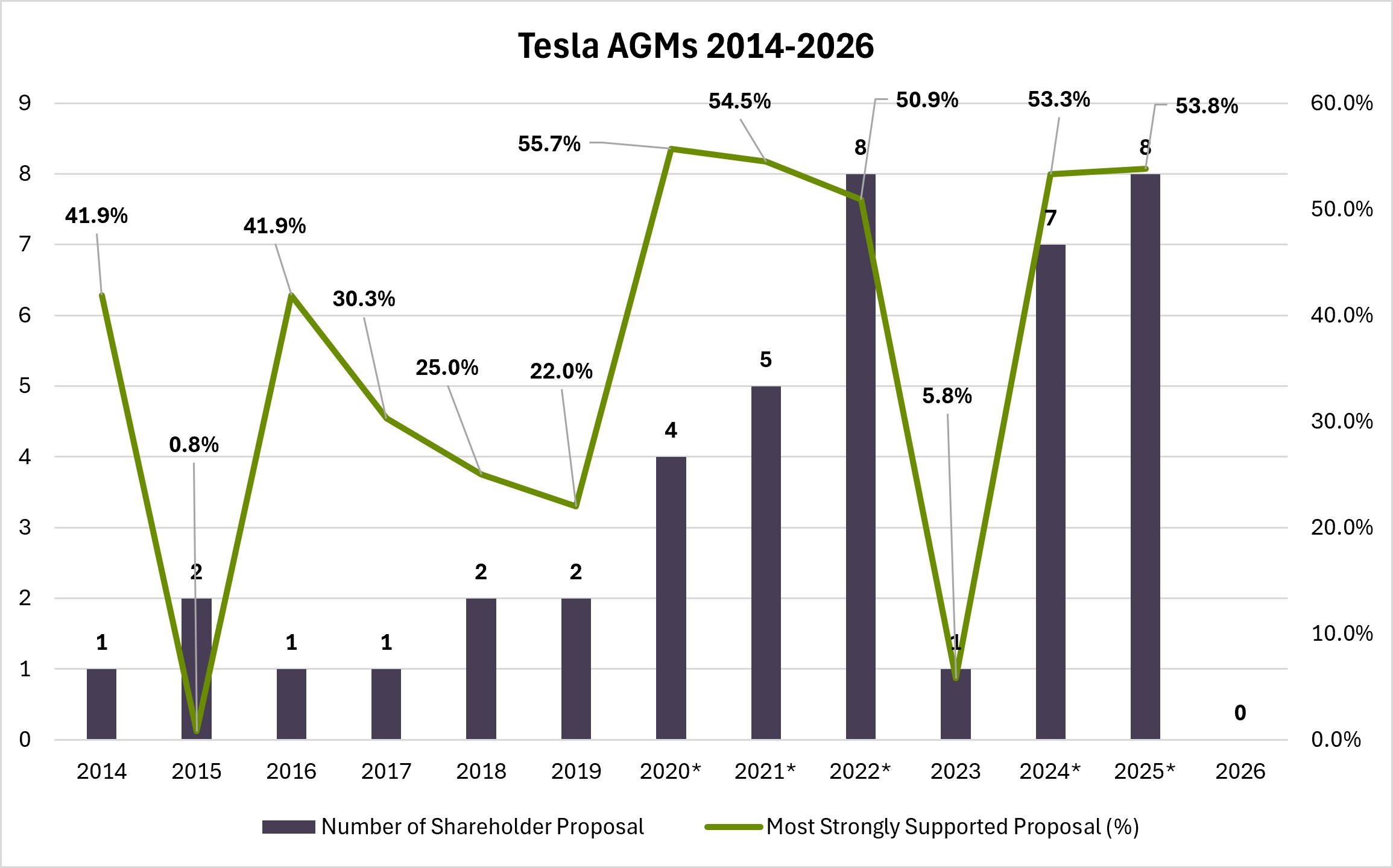
*Shows the AGMs where at least one shareholder proposal passed. Two proposals passed in 2022.
There have been six successful shareholder proposals at Tesla’s last six AGMs between 2020 and 2025. Most recently, a proposal request that the Board take the steps necessary to de-classify the Board passed at its 2025 AGM, while another requesting the elimination of applicable supermajority voting requirements received more than 53% of votes in favour but did not secure the sufficient majority required. There is no board proposal this year to act on the successful resolution from last year’s meeting.
There has also been notable shareholder dissent on other issues, including the executive remuneration for the company’s controversial CEO Elon Musk. One of the management proposals at the firm’s 2026 AGM requests shareholders approve an advisory vote on the remuneration of the Company's named executive officers, with Musk’s 2025 compensation more than U$158 billion.
Tesla’s exclusions offer a glimpse of a US shareholder proposal system in retreat.
The SEC’s Division of Corporation Finance significantly scaled back its 'no action' process in November 2025 for the 2026 proxy season. On 14 August 2026, it went further, announcing it would stop responding to 'no action' requests and Rule 14a-8(j) notifications.
On 16 September, the Commission proposed scrapping Rule 14a-8 altogether, leaving access to companies’ proxy materials to state corporate law and companies’ governing documents. The consultation closes on 20 November.
That proposal came too late to explain Tesla’s empty shareholder ballot. Tesla sought to exclude both proposals in June, notifying the SEC under Rule 14a-8(j), and received responses on 29 July. By then, the Division had stopped substantive reviews on the grounds Tesla invoked but was still issuing responses.
The SEC did not object to either exclusion, relying solely on Tesla’s assurance that reasonable grounds existed. That makes the responses closer to a procedural rubber stamp than an endorsement of Tesla’s legal case. The already ongoing changes to the administration of Rule 14a-8 prior to the 2026 proxy season may also have deterred shareholders from filing proposals, contributing to fewer submissions this year.
Tesla therefore offers a preview of the post-Rule 14a-8 world that investors may need to prepare for.
Changes to Rule 14a-8 are not the only development potentially affecting the influence of active Tesla shareholders.
The company is also introducing a Voluntary Retail Voting Program for future meetings. Shareholders who enroll give Tesla standing instructions to vote with the board, either on all matters or with exceptions for certain contested elections and acquisition, merger or divestiture proposals. Investors can override or cancel those instructions, but the proxy does not describe an equivalent standing instruction to vote against the board. Tesla's programme also offers a template for other companies to adopt their own without seeking approval from the SEC.
The significance for stewardship goes beyond higher retail participation. If the programme succeeds in substantially increasing the number of shares routinely voted in line with board recommendations, it could alter the voting dynamics faced by active shareholders seeking change.
One potentially significant issue that shareholders do not currently appear set to vote on at Tesla’s 2026 AGM is a possible merger with SpaceX. The two companies have formed independent special committees to explore a potential merger, although no terms have been agreed and Musk has cautioned that a deal is not certain. He has also said that any combination would require approval from 50% of all Tesla shareholders.
The potential merger would also raise the questions of the combined company’s share structure, given that SpaceX utilises a dual-class share structure (DCSS). Minerva Analytics highlighted how SpaceX’s DCSS and controlled-company status leave public investors with limited influence, a concept explored more deeply in a separate Minerva briefing.
For institutional investors, an empty shareholder ballot is not evidence of an accountable board. Tesla’s 2026 AGM highlights the risk of mistaking fewer resolutions for fewer concerns. As access to the ballot narrows and standing retail instructions potentially strengthen board-aligned voting, proposal counts and headline voting results may become less reliable measures of shareholder sentiment.
Stewardship teams will increasingly need to look beyond the published ballot at which proposals were submitted, challenged, excluded or withdrawn, and how boards responded to concerns raised through other engagement. The primary test for good governance is not simply whether management wins the vote, but whether shareholders retain meaningful ways to challenge it.