20 November 2026

UK business leaders increasingly view strong corporate governance as a competitive advantage rather than a regulatory burden, according to recent research from the Governance for Growth Investor Campaign (GGIC). The survey from the pension-scheme-backed investor initiative arrives as the UK Government considers reforms that could reshape the country's governance framework.
The survey of 250 senior business leaders suggests many companies regard shareholder accountability mechanisms, including hybrid annual general meetings (AGMs) and annual votes on executive pay, as supporting effective markets. Notably, 88% of respondents said the UK risks losing its standing as a high-quality financial market if governance standards deteriorate. Respondents also linked strong governance with investor confidence and long-term business resilience.
• Strong corporate governance is increasingly viewed as a competitive advantage for UK markets and businesses.
• Hybrid AGMs are seen as an important way of maintaining shareholder accountability while broadening participation.
• Investor scrutiny remains an important component of board engagement and long-term market confidence.
The survey indicates a strong belief that effective corporate governance has become more important to the UK's economic and market position. Eighty-four per cent of respondents said governance should be a greater priority for government than it was five years ago, citing a business environment shaped by geopolitical uncertainty, technological change and artificial intelligence.
Respondents also linked governance standards directly to the attractiveness of UK capital markets. Eighty-eight per cent said the UK risks losing its standing as a high-quality financial market if governance standards deteriorate, while 49% identified effective governance as a factor that helps attract businesses to the country. Seventy-eight per cent described the UK as a market leader or advanced jurisdiction in corporate governance.
The perceived benefits extend beyond market reputation. Sixty-two per cent associated strong governance with greater trust and engagement among stakeholders, while 54% cited improved risk management and long-term resilience and 54% pointed to higher organisational efficiency.
The findings add a notable business perspective to the debate surrounding the Government's Modernising Corporate Reporting consultation. While the consultation is intended to simplify aspects of corporate reporting, the survey suggests many business leaders do not view accountability mechanisms as obstacles to competitiveness. Instead, they see governance standards as one of the factors underpinning the UK's attractiveness as a place to invest and do business.
The survey also found strong support for preserving in-person shareholder engagement. GGIC reported that 83% of listed businesses favour hybrid AGMs, while only 5% support virtual-only meetings. In addition, 87% of business leaders said it is important to meet shareholders in person.
The findings are particularly relevant as the Government considers proposals that would clarify that a virtual location can constitute the legal "place" of an AGM where shareholders consent. Although the consultation does not explicitly endorse virtual-only meetings, investor groups have raised concerns that the changes could make online-only formats easier to adopt.
Those concerns centre on accountability rather than technology. Critics argue that virtual-only AGMs can make it more difficult for shareholders to question directors directly, challenge management publicly and assess board responses in real time. Other concerns include question filtering, technological barriers to participation and reduced transparency around meeting proceedings.
The Investment Association has urged companies to adopt hybrid structures rather than fully virtual arrangements. It has also proposed safeguards including greater transparency around shareholder questions and periodic shareholder reapproval of virtual meeting arrangements. Minerva Analytics has previously examined these issues in its briefing on virtual-only AGMs, concluding that hybrid meetings generally provide a more effective balance between accessibility and accountability than online-only alternatives. The analysis highlighted how hybrid structures can broaden participation while preserving opportunities for direct engagement between boards and shareholders.
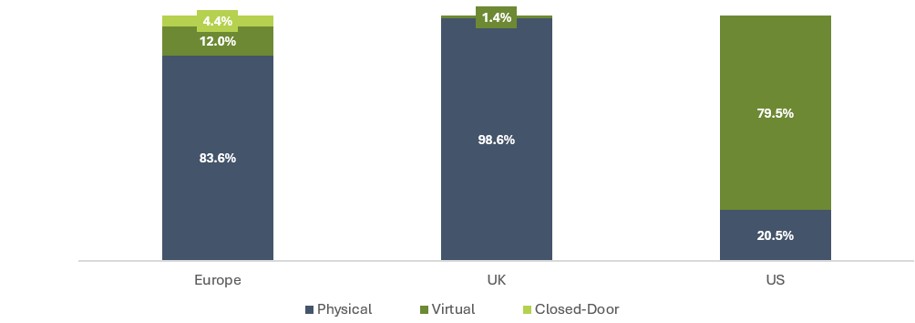
The issue also proved contentious during the 2026 proxy season. At BP's 2026 AGM, shareholders rejected proposals that would have enabled the company to hold fully electronic general meetings, with the resolution failing to secure the support required to amend the company's Articles of Association. BP's 2026 AGM and its rejected virtual-only meeting proposal were explored in Minerva Analytics' 2026 Global Proxy Season Review, which also highlighted that UK companies currently hold significantly fewer virtual AGMs than both the US and Europe, something which could change depending on the outcome of the UK government's ongoing consultation.
The survey found similarly strong support for preserving annual shareholder votes on remuneration reports, one of the UK's most established board accountability mechanisms. According to GGIC, 92% of leaders at publicly listed companies believe the annual advisory remuneration vote plays an important role in board engagement.
Support extends beyond principle. Thirty-seven per cent of listed companies identified the annual remuneration vote as a useful mechanism for signalling shareholder concerns and encouraging engagement between investors and boards, while only 5% said the process provides no meaningful benefit.
For investors, remuneration votes often provide an early indication of broader governance concerns and can prompt engagement before issues escalate into more significant disputes. The findings therefore reinforce the broader survey message that business leaders continue to value shareholder oversight mechanisms as part of effective corporate governance and market confidence.
The Government's Modernising Corporate Reporting consultation closes on 30 November 2026. As ministers consider how to simplify reporting requirements, the GGIC findings suggest substantial business support for maintaining governance and accountability mechanisms, including strong corporate governance standards, hybrid AGMs and annual shareholder scrutiny of executive pay, reflecting a broader view among business leaders that these measures strengthen rather than weaken the UK's competitiveness.