.svg)
The US Securities and Exchange Commission (SEC) has declined to take enforcement action against members of investor-led initiative Climate Action 100+ (CA100+) over their involvement in ExxonMobil's 2021 board election contest. However, a warning accompanying the decision signals that collaborative investor engagement is likely to remain under close regulatory scrutiny.
The SEC concluded its investigation into whether investors involved in CA100+ coordinated support for activist hedge fund Engine No. 1 during ExxonMobil's high-profile 2021 proxy battle in a manner that could have triggered additional disclosure obligations under US securities law.
Engine No. 1 argued that ExxonMobil had failed to adapt its strategy to the energy transition and ultimately secured three seats on the company's board.
While the SEC did not allege violations or pursue charges, it highlighted concerns that coordinated engagement through investor coalitions could result in the formation of a shareholder "group" under beneficial ownership rules. The Commission also raised questions over whether participation in company-specific campaigns could affect an asset manager's eligibility to file a Schedule 13G rather than the more detailed Schedule 13D.
The outcome is significant because it establishes a precedent in which investors avoid enforcement action while still receiving a clear warning that collaborative stewardship activities may attract greater scrutiny in future.
Among the firms drawn into the investigation were BlackRock and State Street, both members of CA100+ during the period under review.
The SEC suggested that some pension fund members associated with the initiative encouraged asset managers to take stronger positions on ExxonMobil's climate strategy and governance. Yet the Commission also acknowledged that it found no evidence BlackRock or State Street had agreed in advance to vote their proxies in a particular way during the contest.
Instead, investors assessed Engine No. 1's campaign independently and voted accordingly.
The experience nevertheless appears to have influenced participation in investor coalitions. BlackRock, which joined CA100+ in 2020, stepped back from the initiative in 2024, citing legal considerations. State Street also exited the group amid growing political and regulatory scrutiny of climate-related engagement activities.
For the broader asset management sector, the report serves as a reminder that stewardship conducted through investor networks may face increasing examination, even where regulators ultimately determine that enforcement action is not warranted.
The SEC's decision was also announced shortly after Ceres - the organisation which coordinates CA100+'s work in North America - confirmed its CEO will step down at the end of 2027 after spending 23 years in the role. The investigation placed Ceres under pressure for several years over allegations that it helped coordinate investor engagement and proxy-voting efforts through CA100+.
The most notable aspect of the SEC's announcement may be the contrast between its findings and its response.
After a lengthy investigation, the Commission concluded there was insufficient basis to bring charges against CA100+ members or associated investors. Had evidence of securities law breaches emerged, enforcement action would likely have followed. Instead, the SEC chose to publish a Section 21(a) Report of Investigation warning investors about the potential regulatory implications of coordinated stewardship activity.
The report arrives amid a broader political and legal debate over climate-focused investor engagement. In recent years, ESG initiatives, investor coalitions and stewardship programmes have faced increasing scrutiny from lawmakers, state attorneys general and advocacy groups alleging coordinated conduct among large asset managers.
The publication is also notable given the direction of the SEC under Chair Paul Atkins, who has emphasised the agency's traditional priorities of investor protection, orderly markets and capital formation. Critics argue that the Commission has become increasingly willing to scrutinise climate-related shareholder activity while placing less attention on corporate mechanisms that may strengthen management influence over voting outcomes.
That criticism gained prominence during the Exxon investigation. The SEC devoted significant resources to examining climate-related stewardship activities but ultimately declined to bring charges against any of the major participants.
For many investors, the concern is not solely regulatory burden but the potential chilling effect on stewardship itself. Climate risk is increasingly viewed as a financial risk with implications for asset values, infrastructure, insurance markets, supply chains and long-term economic growth. Collaborative engagement has become an established feature of modern stewardship, particularly on issues that extend across industries and markets.
The SEC's report leaves investors in an unusual position: no enforcement action was taken, yet the accompanying warning may discourage future participation in collaborative engagement initiatives.
Data from Minerva Analytics shows a marked decline in shareholder proposals at Exxon during the company's last three annual general meetings, reflecting a more challenging environment for investors seeking to bring resolutions to a vote. Support for the most successful shareholder proposal also declined over the same period.
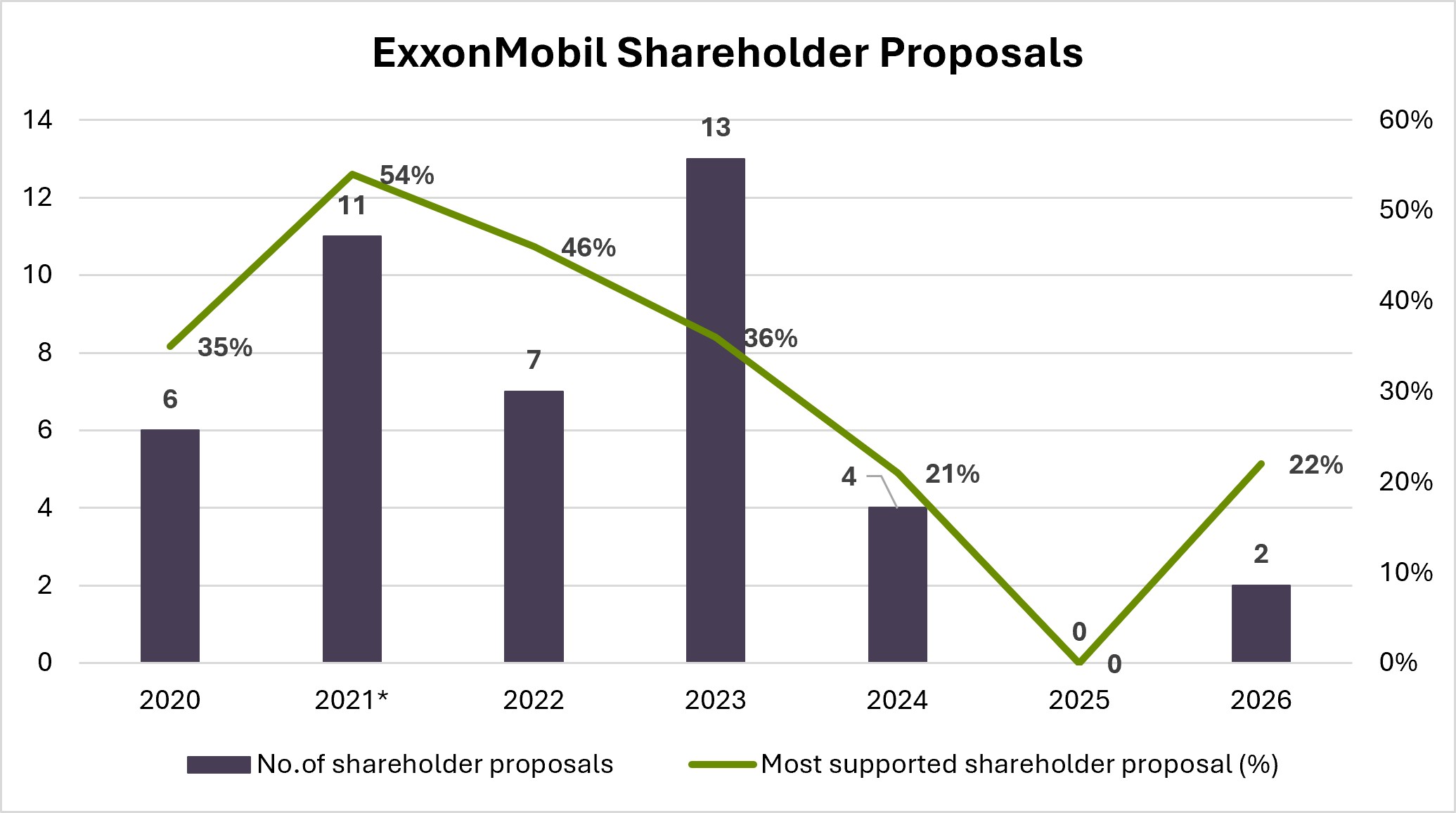
*The number of shareholder proposals for 2021 includes the four proposals on contested director elections. The most supported shareholder proposal figure was the most supported resolution excluding the four on director elections.
Given ExxonMobil's scale and continuing exposure to risks associated with the energy transition, shareholder oversight remains an important mechanism for investors seeking accountability on long-term strategy, capital allocation and climate-related risks.
The contrast between the SEC's approach to collaborative stewardship and its treatment of corporate voting mechanisms has also attracted attention.
Last year, Exxon received SEC approval to introduce a Retail Voting Program (RVP), allowing participating retail investors to enrol in a system under which votes can automatically be cast in line with board recommendations unless shareholders actively choose otherwise. Goldman Sachs and Tesla have since received approval for similar programmes.
Supporters argue that such programmes could improve participation among retail investors, whose voting rates have historically been low. Critics counter that they risk converting shareholder apathy into management support, particularly where investors do not actively engage with governance issues.
Investor coalitions engaging on climate-related financial risks have faced investigations and regulatory scrutiny. At the same time, some of the market's largest companies have received approval for voting mechanisms that may increase the proportion of votes cast in line with management recommendations. The differing regulatory emphasis has not gone unnoticed by stewardship professionals.
CA100+, Ceres and the investors involved in the investigation can point to a significant outcome: after years of scrutiny surrounding one of the most consequential stewardship contests of the past decade, the SEC ultimately chose not to pursue enforcement action.
Yet the broader significance of the report lies in the precedent it sets. Investors escaped penalties, but the Commission used the opportunity to signal that collaborative engagement on company-specific issues could attract closer attention under beneficial ownership and disclosure rules.
The investigation may ultimately be remembered less for what the SEC found than for the message it sent. The warning attached to a decision not to enforce raises new questions about how far investors can collaborate on material financial risks before attracting regulatory scrutiny themselves. For advocates of active ownership, that may prove to be the report's most enduring legacy.


.jpg)