.svg)
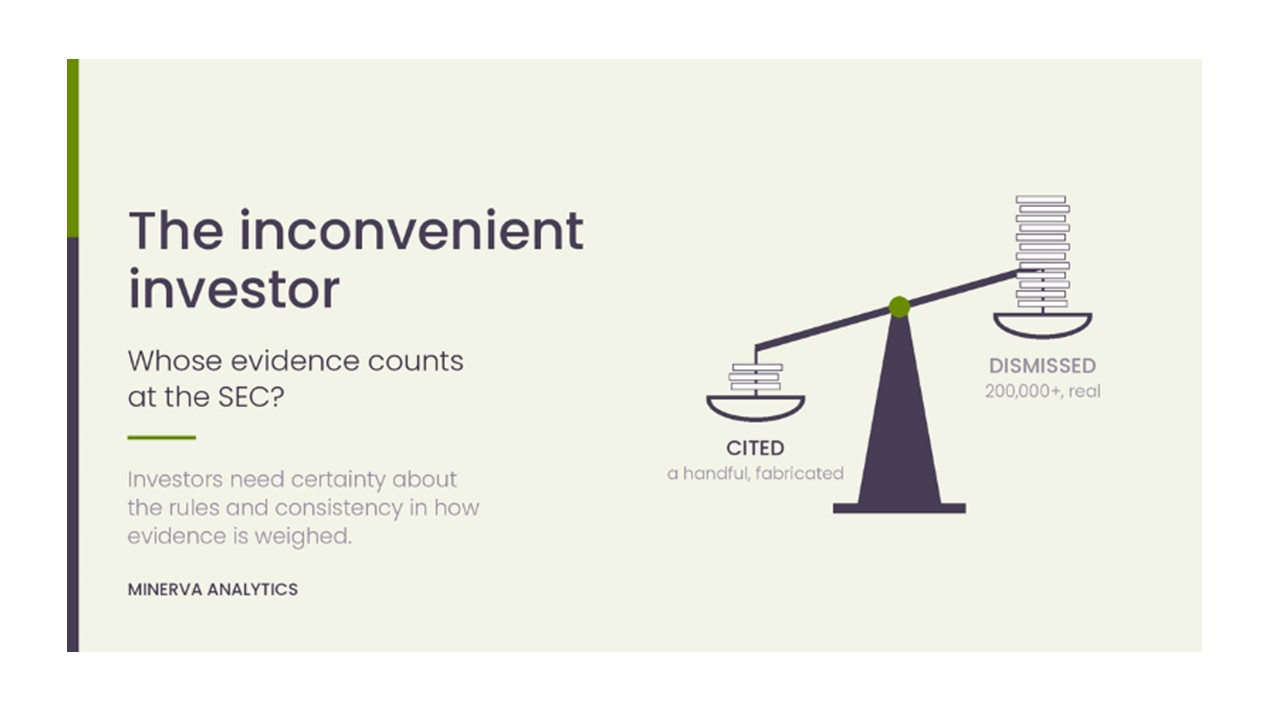
Investors need two things from a regulator. The first is certainty about the rules, which is genuinely hard to deliver in a market that keeps changing. The second is consistency in how evidence is weighed, which ought to be easier, or at least more understandable. It is the second that the US Securities and Exchange Commission has lately made difficult to read. John Reed Stark and Michelle Leder have both been sounding the alarm on the disclosure side. And they should know: both have spent the past two decades on either side of the SEC fence, John in the Division of Enforcement, and Michelle reading the filings the Commission now proposes to halve. There appears to be a pattern worth looking at.
Let's consider two topical episodes.
In November 2019, Chairman Jay Clayton cited comment letters from what he described as "long-term Main Street investors" in support of proposals to bring proxy advice within the reach of the solicitation rules. Bloomberg reporters contacted the purported authors. Among them were an Army veteran, a Marine veteran, a police officer, a retired teacher and a single mother. Several said they had not written the letters attributed to them. The letters were connected to the 60 Plus Association, a member of the Main Street Investors Coalition, which was itself backed by the National Association of Manufacturers. Senator Chris Van Hollen put the matter to the Chairman at a Senate Banking Committee hearing that same December. The General Counsel and the Inspector General were notified. Six months later he was still asking what had been found. Nothing appears to have been published since.
The rules were adopted in 2020. Their central provisions were rescinded in 2022, and the remaining solicitation theory was rejected in litigation in 2024.
In May 2026, the Commission proposed allowing public companies to file a semi-annual report on a new Form 10-S in place of three quarterly reports on Form 10-Q, a change Chairman Paul Atkins presented as the first step of a wider effort to reshape public company reporting, under the heading of making initial public offerings attractive again. The comment period closed on 6 July. More than two hundred thousand letters were filed, the largest response to any rulemaking in the agency's history. A tracker maintained at the Fisher College of Business, which has classified every letter individually and published its methodology, records opposition at 99.5% of those classified. Asked about the response, the Chairman suggested that a common thread running through the letters was a misunderstanding of what the proposal does.
So the retail investor was decisive when the letters were manufactured, and confused when they were real?
OK, so rulemaking is not a referendum. But agencies are required to give reasoned consideration to comments, not just to count them, and a proposal supported by good analysis should survive an unpopular consultation. That is as it should be, but it's not what's at issue here. The question is not whether the Commission must follow the majority. It's why the same body treats the retail investor as an authoritative witness in one consultation and as a confused bystander in another, without ever explaining what distinguishes the two.
Consistency in the treatment of evidence is not a procedural nicety. It's what allows anyone to predict how a regulator will behave.
Which brings us to the harder question. If the investor is invoked when convenient and set aside when inconvenient, then investor protection is not what's at the heart of these decisions. Something else is, and the investor is supplying the cover. That should concern anyone who has been told that restrictions on research, voting advice or disclosure are being imposed on their behalf.
For asset owners and trustees the practical consequence is uncomfortable but clear enough. Investor-protection framing cannot be relied upon to predict where regulation is heading, because it has been used simultaneously to justify tightening the flow of governance information and loosening the flow of financial information. Anyone whose fiduciary duty requires them to consider financially material risk will need their own evidential basis for what they do, documented and defensible, rather than an assumption that the regulatory direction of travel will support it.
Quarterly reporting has been part of the American disclosure settlement since 1970. Whether it should continue in its present form is a legitimate question, and there are serious arguments about compliance cost and reporting burden that deserve a proper hearing. But the case has to be made honestly. Recruiting fictitious Main Street investors to support one proposition, then dismissing two hundred thousand real ones on another, is not an argument. It's an unwelcome habit.
Disclaimer:
Declaration of interest, a practice that appears to be falling out of fashion. Minerva Analytics provides proxy voting research and shareholder stewardship services, and was therefore among the firms on the receiving end of the 2019 and 2020 rulemaking described above. We have a dog in this fight. We are telling you so ourselves, which is rather the point.

.jpg)